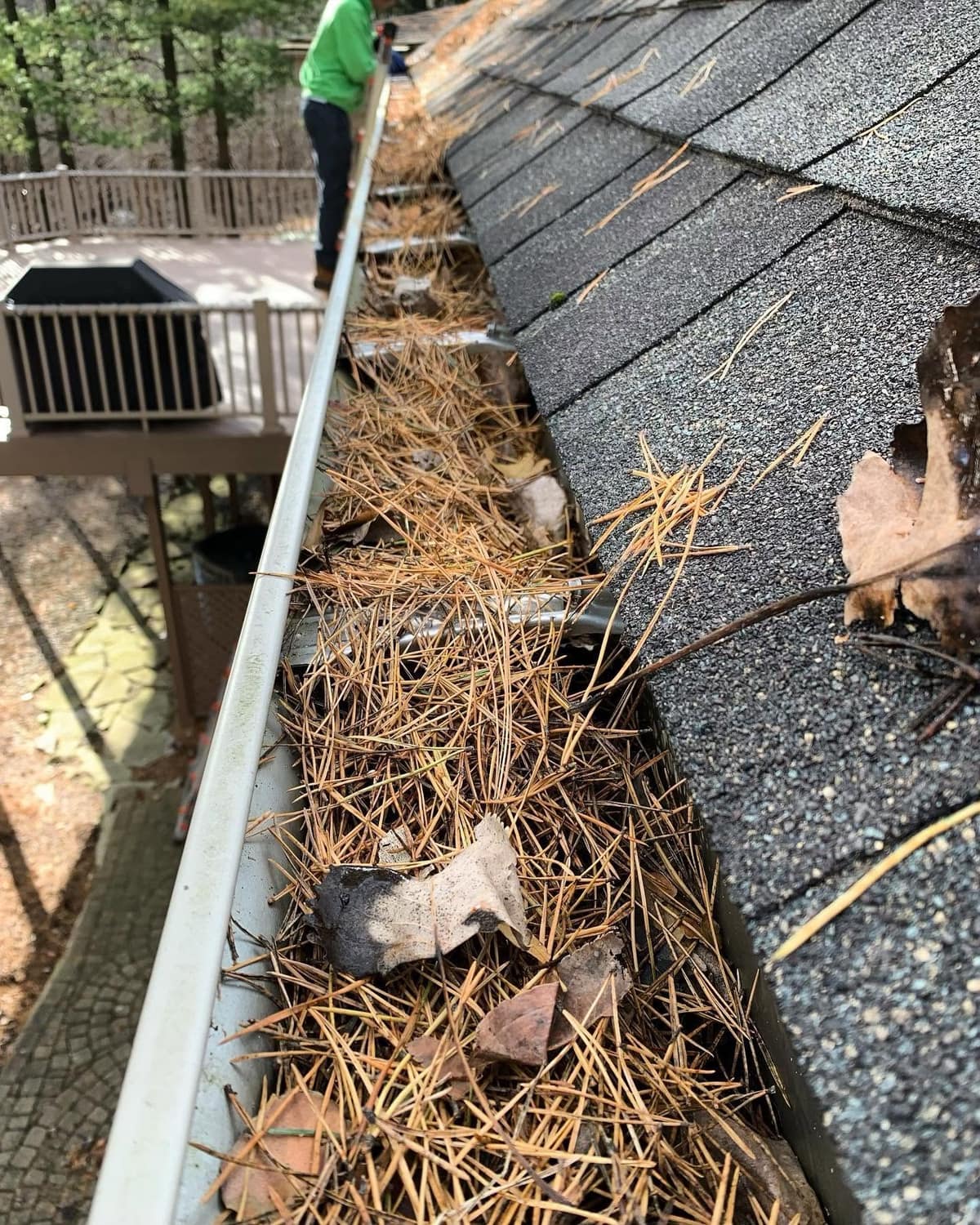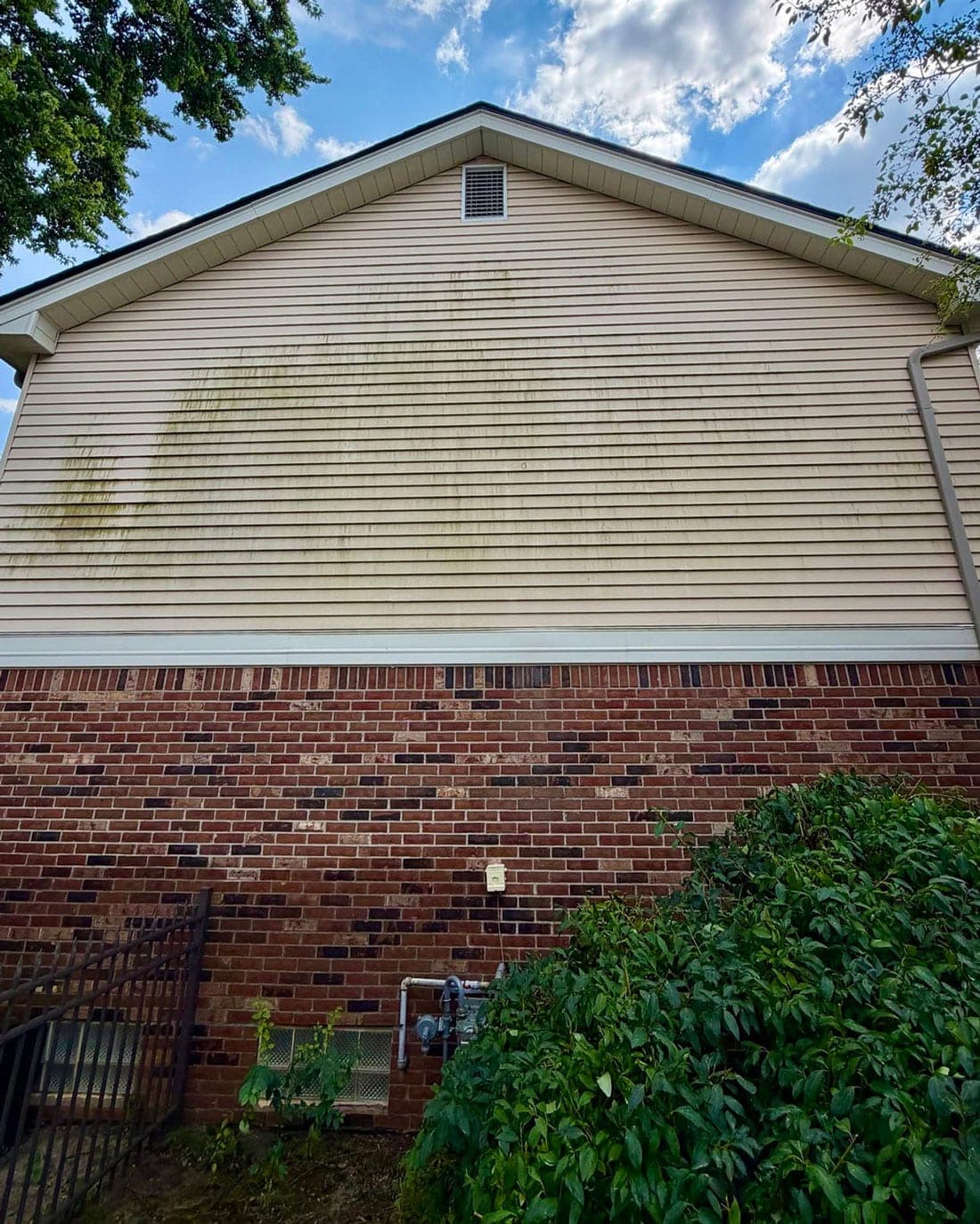
Pressure washing vs soft washing is a choice about what does the cleaning. Pressure washing uses force, a narrow jet of water fast enough to knock dirt loose. Soft washing uses a cleaner sprayed on at about garden-hose pressure, left on the wall long enough to kill the algae and mildew, then rinsed off gently. On a Michigan house the concrete and pavers can take the force. Vinyl, painted aluminum, brick, cedar and the soffits get the soft wash, because force on those does damage that shows up later.
The difference, surface by surface
This is how we split the house on every pressure washing and soft washing job.
Surface | Method | Why |
|---|---|---|
Vinyl siding | Soft wash | Panels hang loose on their nails so they can move with the temperature, and water aimed upward runs in behind them |
Painted aluminum siding | Soft wash after a test spot | Old factory paint chalks, and scrubbing it leaves patches |
Brick and painted brick | Low pressure with a cleaner | The mortar wears away long before the brick does |
Cedar and wood siding | Low pressure, along the grain | Cross-grain pressure roughs up the wood, and it dries fuzzy |
Fiber cement | Low pressure, set for the board | Each material takes a different amount |
Soffits, fascia and gutter fronts | Soft wash | Water driven up into a soffit has no easy way out |
Concrete drives, walks and porches | Pressure through a surface cleaner | It leaves an even finish with no stripes; edges and steps get a gentler hand wand |
Brick and concrete pavers | Reduced pressure | A strong jet empties the sand from the joints |
Salt-scaled concrete | Low pressure, with a warning first | Full pressure takes more of the flaking face off |
Wood decks and fences | Low pressure, wood cleaner, along the grain | The grain stays down, so stain goes on evenly later |
Composite decking | Soft wash | It scratches easily, and the maker's warranty may cap the pressure |
Windows | No pressure, cleaned after the wash | Rinse water dries on the glass |
Why siding gets a soft wash
Vinyl siding is built to move. The Vinyl Siding Institute's installation manual says a panel can grow or shrink half an inch or more over a 12 foot 6 inch length as the temperature swings, so installers leave the nails a dime's thickness loose and the laps unsealed. The manual also calls the siding a cladding that cuts down the water reaching the wall, with a water-resistive barrier behind it to stop whatever gets past.
That loose, lapped design is what a pressure washer exploits. A jet aimed up from the lawn drives water under the laps and into the wall, where it dries slowly. A gas washer running at 3,000 psi can also crack panels and blow the caulk out from around the windows.
CertainTeed does not recommend power washing its vinyl or polymer siding, and gives moisture getting in, damage and discoloration as the reasons. The cleaning steps in the VSI manual use a garden hose, a soft car-wash brush, a detergent mix with laundry bleach added for mildew, and a bottom-to-top wash so the wall doesn't streak. None of that calls for high pressure.
Then there is the growth itself. The green and black film on a north wall is alive: algae and mildew rooted into the texture of the siding. Purdue Extension places mildew on walls behind trees and shrubs, where the air sits still and the wall stays damp. Force tears off the top of that growth and leaves enough behind to grow back within a season.
What the cleaner does to algae
A house-wash cleaner has two jobs. The detergent loosens greasy road film and helps the solution cling, and the National Park Service's masonry cleaning brief names oily soil as what detergents lift best. The bleach kills the algae and mildew and takes the stain out with it.
The published recipes agree on that pairing. Purdue Extension's mix for mildew on painted siding is household detergent, household bleach and warm water, and the vinyl siding manual adds laundry bleach to its detergent wash when mildew is the problem. Purdue's test for telling growth from dirt works on any wall: put a drop of household bleach on a dark spot, and mildew bleaches out in a minute or two while dirt stays put.
Next, the cleaner needs time on the wall. That wait kills the growth at the root, and it is the reason a soft-washed wall holds up for a season or more. A low-pressure rinse carries the dead growth away. The cleaner also needs warm weather, one reason washing in Michigan runs from April to November.
Brick, mortar and cedar take low pressure
Brick is hard. The mortar between the bricks is softer, and it sets the limit. The National Park Service's Preservation Brief 1 tells owners of masonry buildings to start washing at 100 psi or below, as gentle as a garden hose, and to work up only as needed, to 300 to 400 psi at the top end. It warns that lime mortar wears away under abrasive or mechanical cleaning, that joints can make up as much as 20 percent of a brick wall's face, and that eroded joints let more water into the wall.
Older houses in downtown Northville, and in Plymouth by Kellogg Park, were laid with soft lime mortar. The postwar brick ranches across Livonia sit under mature street trees that keep their walls in shade and their joints dark. Both get a cleaner and a low-pressure rinse.
Wood is softer again. Historic New England's washing guide puts a garden hose at 40 to 60 psi and caps wood at 100 psi, and lists water forced behind the boards and a raised grain among the risks of going higher. We clean cedar at low pressure along the grain, so the fibers lie flat and the wood dries smooth.
Why concrete gets pressure, and when it shouldn't
Concrete has no laps or paint for water to get behind, and the dirt on it is a different kind. Tire marks, road film and winter salt residue sit on top of the slab, and force lifts them.
The tool matters more than the pressure. A hand wand cleans a stripe a few inches wide, and no two passes land quite the same, so a driveway done with a wand dries with light and dark bands etched into its texture. A surface cleaner is a round hood with a spinning bar inside that holds the nozzles at one height, so the whole width gets the same pressure. It handles the open slab, and the edges, joints and steps get a hand wand turned down low.
Some concrete needs less. Pavers sit on sand with sand in the joints, and a jet aimed at those joints empties them. Stamped and colored patios, common on Novi houses from the 2000s, have their color and sealer right at the surface, and full pressure strips both. Canton drives and garage aprons take a whole winter of salt, and salt speeds up the freeze-thaw damage that makes concrete flake. A slab that has started to scale, with the top flaking off and the stone showing through, gets low pressure and a straight answer before we start. It will come up cleaner, and it will still look like old concrete.
Decks and fences
Wood decks and fences are washed gently, using a wood cleaner and moving with the grain. That lifts the grey layer and the algae and leaves the grain lying flat. Raised grain feels rough underfoot and soaks up stain in blotches. Planning to stain? Book the wash for spring, so the wood has time to dry out before the stain goes on.
Composite boards get a soft wash. They scratch easily, and the maker's warranty may cap the pressure, so read it first.
What happens to your windows
Every house wash spots the windows. The rinse sheets down each wall, crosses the glass and dries there with whatever it picked up on the way. We rinse the glass as we go, and it still needs a proper cleaning afterward.
That is why the order matters when you book more than one job: the house, then the gutters, and the windows last. Washing the gutters or the glass first means doing them twice. Booking the house wash alone? Put a window cleaning on the calendar right after it. The glass itself never needs pressure, and a jet near the frames can blow out the caulk.
How to tell which method a quote is using
You can ask any company these questions, us included:
What pressure goes on the siding, and what goes on the concrete?
What cleaner goes on the walls, and how long does it sit before the rinse?
Will the beds and shrubs be soaked before the cleaner goes on, and rinsed again after?
Is the driveway cleaned with a surface cleaner or a wand?
Will the brick or the aluminum be tested on a low spot first?
What will the windows look like when the job is done?
A company that soft washes will answer each one in a sentence.
Questions people ask
What is the difference between pressure washing and soft washing?
Pressure washing cleans with the force of a high-pressure jet. Soft washing cleans with a cleaner sprayed on at about garden-hose pressure, left to kill the algae and mildew, then rinsed off gently. Concrete and pavers can take the force. Vinyl, painted aluminum, brick, cedar and soffits get the soft wash, since force damages them.
Can pressure washing damage windows?
Yes. A high-pressure jet can blow the caulk out from around window frames, and on older sash it can loosen the glazing putty. The glass itself needs no pressure. During a house wash the jet stays off the windows, the glass gets rinsed as we go, and it needs a proper cleaning once the house and gutters are done.
Does soft washing cost more than pressure washing?
The method follows the surface, so the two don't compete for the same job. Siding, concrete and decks are each quoted on their own. A house wash is priced from the size and height of the house and how much growth is on it, and concrete from its square footage and condition. The quote is free.
Is a soft wash strong enough to clean a house?
Yes. The cleaner kills the algae and mildew rooted into the siding, and a gentle rinse carries them away. High pressure strips the top layer and leaves enough behind to regrow, so shaded walls go green again within months. A soft-washed wall stays clean for a season or more, and the siding stays undamaged.
Can concrete be damaged by pressure washing?
Yes. A hand wand held close cleans in narrow strips and can etch them into the concrete as a texture that never washes out. A surface cleaner holds its nozzles at one height and leaves an even finish. Concrete already flaking from salt and freeze-thaw loses more of its face under full pressure, so it gets a gentle wash.
Get a quote
Glass Guru has been owner-operated in Northville since 2014. We soft wash siding and pressure wash concrete from April to November across ten towns, from Canton up to Birmingham, and every one of them is listed on our pressure washing service areas page. Tell us the address and which parts need washing, and a quote comes back to you. Get a Free Quote